How to Conclude a College Essay
One of my favorite concluding paragraphs waddled ashore in a 2014 piece by longtime New York Times columnist Gail Collins, who is a master of expressing complex ideas simply and rendering devastating judgments cheerfully.

One of my favorite concluding paragraphs waddled ashore in a 2014 piece by longtime New York Times columnist Gail Collins, who is a master of expressing complex ideas simply and rendering devastating judgments cheerfully.
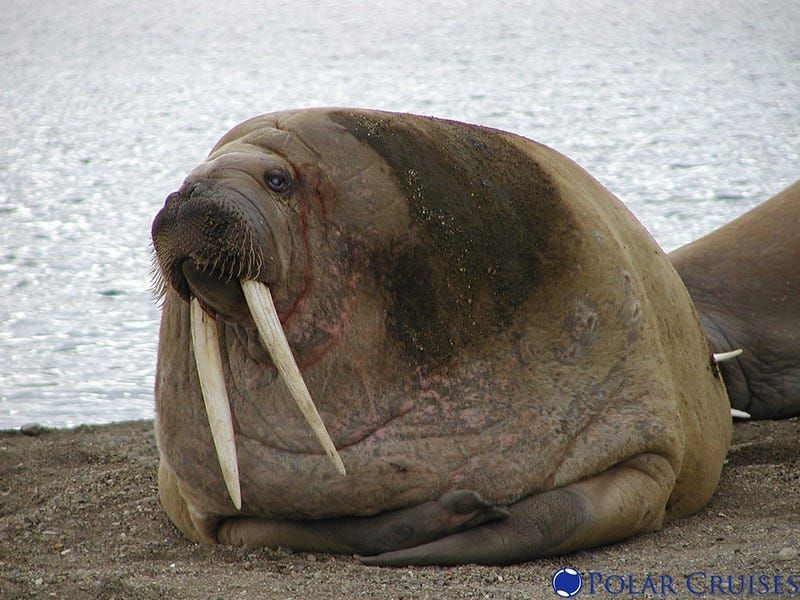
“We,” Collins writes, “are the walrus.”
On its own, Collins’s conclusion is nearly nonsensical. Its power comes from its exquisite relationship with the preceding paragraphs, in which Collins lays out the urgency of the climate change crisis.
At this point, I will invite you to imagine what her conclusion means — can you discern any connection between the global climate and walruses? Or, rather, “the” walrus?
Collin’s essay opens with an excruciating appeal to pathos. She describes the plight of walruses in the Arctic, starving for lack of fish to eat and crowded for lack of solid ice on which to perch. It’s a terrifying situation, if you are a walrus.
Her succeeding paragraphs tell us why people should care, leading to the conclusion that, as goes the walrus species (hence “the walrus” rather than “walruses”) so goes the human species — “we,” in its broadest conception. This twist of ungrammatical, but ultimately accurate wordplay, is chilling.
Collins’s enlistment of The Beatles adds some whimsy. The connection, though, is not entirely arbitrary. “I am the Walrus” invokes surrealism. Collins tells us that nothing is more surreal than the murder of a perfectly good planet.
Conclusions can be confounding. A conclusion often warrants a completely different thought process compared to the body of an essay — whether it’s a narrative or an analysis — and even compared to an introduction. Conclusions must look backward, to the body of the essay and, often, to the conclusion. And they must look forward to the reader’s lingering thoughts.
Conclusions must achieve a fine balance. They can be brief, but they should not be trite. They must acknowledge the preceding paragraphs but not restate them.
They should, in some way, present a new idea. But, the idea they present should not be so new that it seems incomplete or detached from the rest of the essay.
Conclusions should also convey the writer’s sincere reaction to his, her, or their own essay. Writers should consider, “How do I think or feel differently now that I’ve drafted this essay and sat with it?” Ideally, a good essay should change its own author’s mind, at least a little.
And, conlcusions should look outward, give readers something to think about.
Before we think about what conclusions can be, let’s discuss what they should avoid:
- First, don’t be overeager to write a conclusion. Give yourself a few drafts of the body of the essay first. Make sure you know what the essay is really saying. Then you can draft a conclusion.
- Avoid summarizing, and avoid repeating. You know what you’ve written, and readers know what they’ve read, especially in a short piece of writing. They don’t need to read it twice.
- Unless you find inspiration on your very first draft, you should not force yourself to write a conclusion immediately. You should wait until you’ve refined the body of your essay. Ideas and narratives in the body might change from draft to draft. You don’t want to lock in a conclusion when you haven’t yet sorted through all of your thoughts. And, you may simply need time to let your concluding ideas develop.
- Avoid self-congratulation or any other overt value judgments. Don’t tell us that you’re awesome — or that something else is awful. Help us infer the awesomeness; help us understand the awfulness.
- Don’t tell us what you’ve “learned” or “realized” — especially if it’s something obvious or trite. All that does is highlight a prior state of ignorance or naïveté.
- Avoid reciting common knowledge.
- Don’t refer to some vague personal virtue, such as resilience or leadership. Those concepts are meaningless. If your essay embodies a virtue, readers will infer it without explicit mention.
Here are a few proactive approaches:
Tell us why you care. Stories lend themselves to many different interpretations. A reader might pick up on an angle that’s different from the one that you intend to emphasize. That’s OK. Ultimately, though, it’s your essay, and it’s your conclusion. Tell us exactly why the story you have told is important to you.
“I haven’t seen Mr. Smith in over a year. I hope he’s enjoying his new school, and I know I am enjoying the study of physics, which he so enthusiastically introduced to me.”
Make the reader care. Your essay might recount a story about something important to you. But your story isn’t necessarily important to a reader — until you explain its relevance. Try to identify some element in your story that might be instructive or enlightening to someone else.
“Building a 1/100th scale suspension bridge in my backyard has, I hope, prepared me to study civil engineering. It has also helped me appreciate the forces that keep all of us high and dry as we drive over rivers, canyons, and straits.”
Describe what the future might hold. This doesn’t mean that you should necessarily express a personal ambition (unless you’re writing a “Why Essay”). Instead, it could be a general prediction about the future, whether optimistic or pessimistic.
“It was the Boys and Girls Club’s first ceramics show. But, I hope it will not be the last.”
“The election of Mayor Lee was a travesty of democracy, for sure. But, I have faith that if I, a high school student, can do my research and understand the evils of corruption, my fellow citizens and voters can too.”
Identify a value or theme (after you’ve written the essay, not before) that you can expound on in the conclusion.
“Cooking mac and cheese for my little sister does not qualify me to join the staff of a Michelin-starred restaurant. But, she appreciated my efforts after a rough day. To my surprise, I found her appraisal as satisfying as any rave review I might get someday.”
Articulate something you newly appreciate about yourself.
“Going to Lollapalooza helped me understand that I have terrible musical taste — at least by today’s standards. I’d rather have gone in 1995 than 2025. So, yes, I’m old-fashioned. And that’s OK. I’d like to think Kim Gordon would agree.”
Explain a revelation or realization about the world or other people — but make sure it is surprising, insightful, fresh, or otherwise non-obvious. (i.e., “How have you changed your mind since the essay began?”)
“I wish I hadn’t missed the prayer group. I might not be religious, and I might not believe in a higher power. But Mr. Miller does, and I believe in Mr. Miller. The next time someone asks me for something as simple as my presence, I will be there.”
“I don’t regret all the time I spent collecting bottles and cans for the environmental club. But, I also don’t regret finding out that our recyclables are more likely than not to end up in the landfill. It just means I have to shift my focus, from picking up trash to learning how to change environmental policy.”
Explain a change in your attitudes, beliefs, or behavior. But, be wary of changes that might be trite or obvious, and make sure it is admirable.
“I haven’t been back to the ballet since. But ‘Swan Lake’ continues to swan around my mind. The quickness, athleticism, and coordination are not so different from the skills I use in basketball. Except, on the stage, everyone wins when a production is as beautiful as that one was.”
If your essay has a negative slant — about a failure or disappointment — try to express something positive that might follow from your ideas or stories. If your essay is positive, you might explain how to build on it or acknowledge future obstacles.
“By the end of July 3, I had collected 320 stray shopping carts, taken 15,000 steps, and felt like I was going to die. That day was miserable, and the rest of the summer wasn’t much better. But, thanks to those shopping carts, I still got in shape. By the time football season came around, I was holding the offensive line more fiercely than ever.”
Tell us what you think about the world — on whatever scale you like (school, town, city, country, globe) in light of whatever you’ve written about.
“I’m still not happy about the governor’s approach to juvenile crime. But having spoken to so many knowledgeable people, including accused kids, I understand more of the complexities behind her decision. Including the decision not to pardon my friend Adam.”
Connect (sincerely) to another aspect of your life.
I was sad for the final orchestra concert to end. I’m not sure if I’ll ever perform so intensely with 80 people ever again. But, I have a movie to make and a set of poetry I’m working on. I’ll invest my intensity in them.
Affirm common knowledge.
I now know a lot more about riparian ecosystems than I used to. I also know that poison ivy is every bit as painful as they say it is.
Reading an entire novel seems like a daunting task. Many of my friends would never dream of doing it. But, the six or so hours I spent last week on The Three Musketeers flew by; I’m halfway through Silent Spring, and the pace is similar. when I replace browsing on Instagram with reading books, those pages are a lot more appealing than the posts, comments, and likes.
In parallel with all of the above, one technique that is almost universally fruitful is to look back at your introduction and consider your perspective on it in light of the ideas and stories in the body of your essay. What new perspective have you developed? What more can you add? Which aspect of the introduction is most compelling or provocative? Can you cite a detail from the introduction and evoke it afresh? (E.g. In the example above, “Adam” might have been the subject of an introductory anecdote.)
If you can answer at least one of those questions, you can remind us of where you started — even with a fleeting mention — while giving us a sense of how your thoughts have developed over the preceding sentences and paragraphs.
I don’t know how walruses are doing these days. Not good, I assume. I do know that, if some of this advice resonates with you, then you, too, may be Gail Collins.