Going to College Before You Go to College
Among my high school’s roundabout virtues was its unrelenting emphasis on academic research. I’m not kidding.
As early as 9th grade, teachers in history and English assigned meaty papers that required us to refer to books, periodicals, scholarly journals, and more. We dove into card catalogs, old-fashioned journal indexes, and the Library of Congress indexing system. By junior year, the research our teachers expected us to do far exceeded the collection of our small in-school library.
These days, assignments like these would send students to the Internet, where every book, news article, and academic paper lies, waiting in the abyss of cyberspace. But, back in my day, if you couldn’t pull it off the shelf, or feed it into a microfiche machine, you were out of luck.
Fortunately for us (or at least the nerds among us), my school was about two miles from one of the world’s great research universities: UCLA. So, for at least a few moments each school year, I became a temporary Bruin. I didn’t go to basketball games or sneak into frat parties. Instead, I haunted the libraries.
I spent hours, and sometimes entire days of my weekends, flipping through card catalogs, hiking up stairs, and scanning shelves at Powell Library and Young Research Library to see what I could find about, among other things, drug legalization, Fidel Castro, John Steinbeck, and Romantic poetry. It was there, among the university’s 8 million volumes, that I learned at least a rudimentary version of how to conduct college-level research and, just as importantly, gained comfort on a college campus.
In retrospect, I’m sure I had no idea what I was doing. My research was not exactly systematic. But, I’m equally sure that those awkward perusals helped me get into college and feel comfortable when I got there.
Even if today’s college students can write term papers from the comfort of home, I still encourage all prospective students to spend time on nearby campuses to develop an understanding of what college is like and what colleges offer. Not everyone needs to write two-dozen pages on William Wordsworth’s “Ode: Intimations of Immortality” to get a potentially invaluable glimpse into college.
(Some colleges, especially urban campuses, have entry controls for some areas, especially dorms. But every campus has ample spaces that are publicly accessible.)
Here are some approaches and options:
The Usual Stuff: Yes, take a tour and attend an information session. Information sessions are, typically, godawfully boring, and every presenter speaks as if their college has pioneered or perfected something that literally every other college offers. So, you should bring some specific questions to keep it interesting. With that said, it’s still worthwhile to hear how colleges describe themselves.
Summer Programs: Directly aimed at middle or high school students, many colleges offer summer programming of various subjects and lengths where you can live on, or near, campus and envision yourself experiencing college life. This may be a good opportunity for visiting a new city or state, exploring a field that interests you, meeting other college-minded students, and for better or worse, experiencing dining hall cuisine. Some are explicitly designed to provide a “college experience” to high schoolers (and sometimes middle schoolers) who are otherwise unfamiliar with college.
Audit Classes: There’s no better way to find out what college classes are like than to — spoiler alert! — attend college classes. Most class schedules are posted online, so you can easily identify classes that look interesting and find out when and where they take place. You can email the professor and/or a member of the admissions office for permission if you’d like to sit in. Large lectures are likely to be welcoming; small seminars might be trickier.
Enroll in a Class: Colleges often make summer classes available to high school students, and some have extension schools that offer enrichment classes to the general public. These classes are separate from “summer programs” dedicated to high school students; those programs can be worthwhile, but they’re usually very different from typical college classes.
Public Lectures: In addition to regular classes, colleges frequently invite special speakers for lectures that are open to the public. They might be notable scholars from other colleges, people applying for faculty positions, or, on special occasions, public figures — politicians, artists, businesspeople, etc. — with something interesting to say. You may find lectures on your favorite topic, by a public figure you admire, or discover a new idea altogether.
Arts Performances: College campuses offer a wealth of arts and entertainment: drama, dance, music of all sorts, poetry slams. The list goes on. These performances usually feature undergraduates, but some of the larger events might include professional performers (especially at larger colleges).
Intercollegiate Athletics: The typical college fields at least a dozen varsity athletic teams, if not more. Except for “big” sports — football and basketball, which may require tickets — games are easily accessible. If you’re remotely interested in athletics and competition, you can become a fan of your local college even if you’re otherwise unaffiliated.
Note: Every college has a collegewide events calendar, on which all three of the previous categories will appear. You can easily find this via a quick online search.
Community Service: It’s entirely possible that a college’s student-run service organizations would allow local high schoolers to tag along. They are likely to have access to a wider variety of service projects than most high schools have.
Meals, Beverages, and Coffee: A high school student probably couldn’t eat in a college cafeteria (absent a meal plan), but every college has small cafes where the general public can dine and pay a la carte. High schoolers can grab a drink or a bite, do some studying, and enjoy some people-watching.
Recreation and Fitness: Some colleges give high schoolers access to their fitness facilities. Even if they don’t, fields and courtyards are almost always open for informal soccer, frisbee, grass volleyball, croquet, or, if you must, quidditch. (If you want to relax, just find a nice tree and read some Wordsworth.)
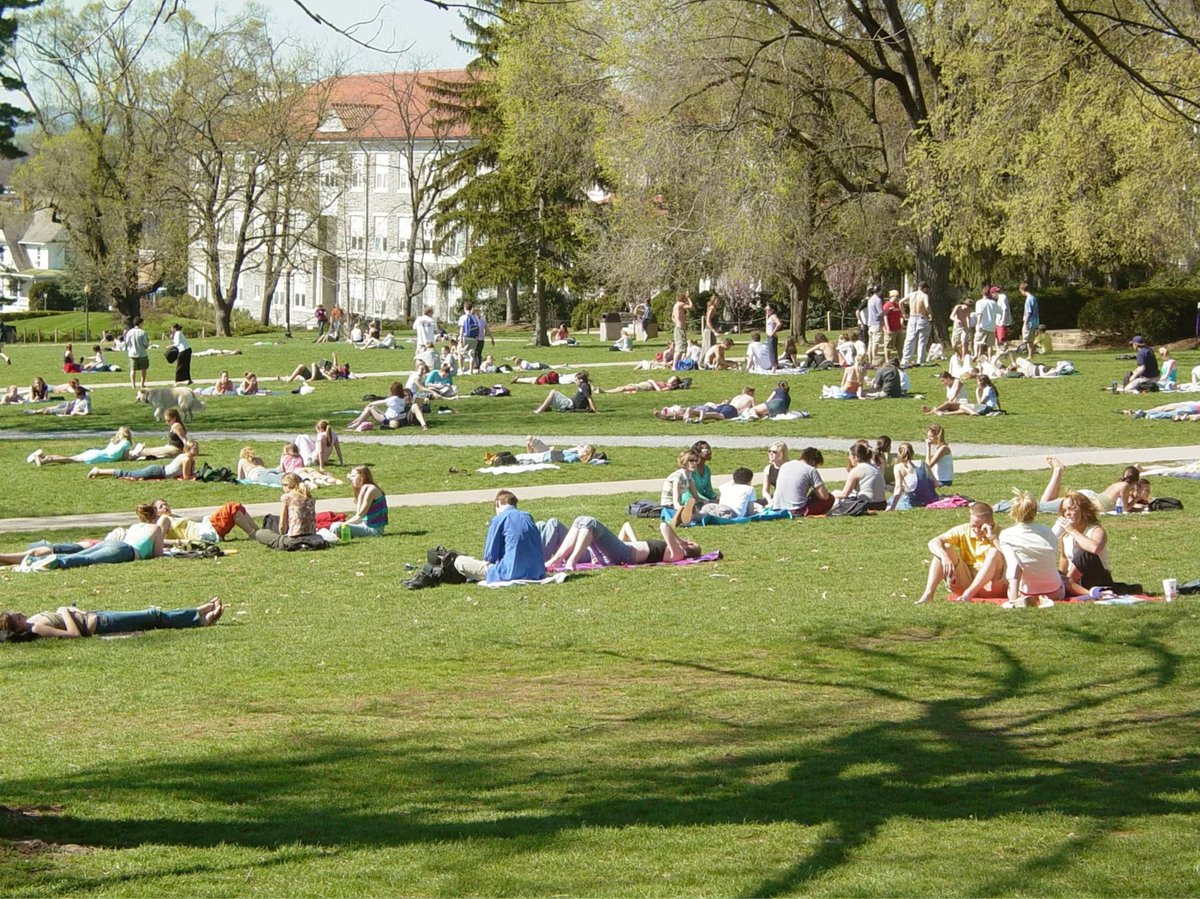
Quads, Courtyards, and “Beaches”: Whereas public spaces in many cities are uninviting or nonexistent, many college campuses are beautiful and welcoming. There are benches for sitting, open spaces for frisbee-tossing, pathways for jogging, and plenty of places to spread out a picnic blanket. No matter how far inland they may be, many colleges wryly refer to big grassy areas as “beaches,” where chilling and reading take place on warm days.
Be Friendly: In any given cafe, courtyard, or hallway, a friendly greeting can do wonders. I’m willing to bet that, if a high school student approaches almost any student on any college campus, that student will be happy to have a chat about what college life is like there.
Eavesdrop: Even if you don’t speak to students directly, you can learn a lot from overhearing their conversations with each other.
Libraries(!!): If you have never navigated a library with more than a few thousand volumes, get ready for some serious browsing. Also, many libraries have lovely “reading rooms” that are ideal for studying.
Reality: The more college tours and information sessions a prospective student attends, the more they’ll be bombarded by superlatives and fantasies about college. Over and over again, you’ll hear colleges tout the exact same “unique” virtue: “distribution requirements! vegan meals! interdisciplinary studies! a quidditch team!” Spending even a few hours on a college campus, no matter how “prestigious” it is, will enable you to see past these stale sales pitches and understand that there is no such thing as a “dream school.”
The College’s Ranking: Nope. A visit won’t reveal how a college is “ranked” or how “prestigious” it is. You can’t tell how accomplished the students are from watching them mill around a quad, and you can’t tell how rigorous the education is from critiquing the architecture. (Some highly ranked colleges are ugly, and some lower ranked colleges are gorgeous.) . Whether you enroll at No. 1 or spend a day at No. 185, a ranking has nothing to do with daily life in college.
Obviously, not everyone lives close enough to a college to hang out on a regular basis. But, every major urban area in the United States has at least one major college, and most have multiple colleges.
New York City: Columbia, Fordham, NYU, and the CUNY’s; Los Angeles: UCLA, Loyola Marymount, Occidental, and USC; Chicago: Univ. of Chicago, DePaul, Northwestern, and Illinois-Chicago; D.C.: Georgetown, George Washington, and Univ. of Maryland.
The list goes on.
The point is, college doesn’t need to be mysterious. And, you can learn a lot about college — and from colleges — long before you enroll. Please note, this is not a way to “hack” the application process. Hanging out on a campus to which you might apply will not give you an advantage.
When you start to form an idea of your own college pursuits, you don’t need to close your eyes, rely on your own imagination, and leap into the void, all along pretending that you’re an expert. Even if you haven’t the slightest intention of attending college near home, everything you learn on your nearby campus can make you savvier and better-informed when you choose the colleges to which you want to apply.
If that information includes insights into nature, youth, and the Romantic imagination, so much the better.
Image Credit: Ben Schulman via Flickr.